
Proforma Invoice vs Commercial Invoice vs Invoice: Differences Explained
Quick answer: A proforma invoice is a preliminary, non-binding bill sent before goods or services are delivered, showing what the buyer will pay. A commercial invoice is the final, legally binding document used in international shipping to declare goods to customs. A standard invoice is the final payment request for a completed sale. Only the commercial invoice and the standard invoice are recorded as sales in your accounts; a proforma is not.
If you have ever been asked by a client, a freight forwarder, or a bank for "a proforma" and weren't sure what to send, you're not alone. The terms proforma invoice, commercial invoice, and plain invoice get used interchangeably — and mixing them up can delay a shipment at customs, confuse your bookkeeping, or leave you charging VAT twice.
This guide explains exactly what each document is, when to use it, what it must contain, and how the three fit together in a real transaction. You'll also find comparison tables, a step-by-step workflow, the most common mistakes, and a FAQ at the end.
What Is a Proforma Invoice?
A proforma invoice (also written "pro forma" or "pro-forma", from the Latin for "as a matter of form") is a good-faith estimate of a sale, formatted like an invoice but issued before the sale is finalised. It tells the buyer: "if you confirm this order, this is what you will be billed."
Because nothing has been delivered yet, a proforma invoice is not a demand for payment in the legal or accounting sense. It does not create a receivable, it isn't entered into your sales ledger, and in most jurisdictions it isn't a valid VAT invoice — so your client can't reclaim tax on it. For a short definition, see our glossary entry on the proforma invoice.
When businesses use a proforma invoice
- To secure upfront payment or a deposit. Many suppliers issue a proforma, collect payment against it, and only then ship or start work.
- For the buyer's internal approval. Corporate clients often need a proforma to raise a purchase order or get budget sign-off.
- For import licences and letters of credit. Banks and some customs authorities ask for a proforma before the goods exist or ship.
- To quote a complex order. It's more formal than a quote, listing exact quantities, unit prices, shipping, and terms.
- For samples or free goods. Items shipped at no charge still need a declared value.
What a proforma invoice should include
- The words "Proforma Invoice" clearly at the top (this is what stops it being mistaken for a real invoice)
- Your business name, address, and contact details; the buyer's details
- Issue date and an expiry or validity date (e.g. "valid for 30 days")
- A description of the goods or services, quantities, unit prices, and totals
- Estimated taxes, shipping, and insurance
- Payment terms and accepted payment methods
- For goods: estimated weight, country of origin, and Incoterms
Notice what's usually missing: a sequential invoice number from your main series. Use a separate reference (for example PF-2031) so your real invoice sequence stays gap-free. Our guide to invoice numbering explains why gaps in your main series cause audit headaches.
What Is a Commercial Invoice?
A commercial invoice is the final bill of sale for goods crossing a border. It serves two purposes at once: it's the seller's request for payment, and it's the primary document customs authorities use to identify the goods, calculate duties and import taxes, and clear the shipment. Read the short version in our commercial invoice glossary entry.
Unlike a proforma, a commercial invoice is legally binding. The values on it must be accurate: under-declaring to reduce duties is customs fraud, and inconsistencies with the packing list or bill of lading are one of the most common reasons shipments get held.
What a commercial invoice must include
Exact requirements vary by country, but customs brokers generally expect:
- Seller (exporter) and buyer (importer) names, addresses, and tax or EORI numbers
- Consignee, if different from the buyer
- Invoice number and date
- A detailed description of each item — "clothing" is not enough; "women's cotton knit sweaters" is
- HS (Harmonized System) code for each item
- Country of origin for each item
- Quantity, unit value, total value, and currency
- Gross and net weight, number of packages
- Incoterms (e.g. EXW, FOB, DAP, DDP) showing who pays freight, insurance, and duties
- Reason for export (sale, sample, repair, return)
- A signed declaration that the information is true and correct
If you only sell services, or only sell domestically, you'll rarely need a commercial invoice. Your standard invoice does the job.
What Is a Standard (Tax) Invoice?
A standard invoice — sometimes called a sales invoice or tax invoice — is the final request for payment after goods or services have been delivered (or on agreed billing dates). It's the document that creates an accounts receivable balance, starts the clock on your payment terms, and is used for VAT/GST reporting.
We cover the mandatory fields in detail in our invoice requirements checklist and how to create an invoice. In short, it needs a unique sequential number, issue date, supply date, seller and buyer details, a clear description, amounts, tax breakdown, total due, due date, and payment instructions.
Proforma vs Commercial vs Standard Invoice: Side-by-Side
| Feature | Proforma invoice | Commercial invoice | Standard invoice |
|---|---|---|---|
| When issued | Before the sale is confirmed or goods ship | When goods ship internationally | After delivery or on billing date |
| Legally binding? | No — an estimate / offer | Yes | Yes |
| Creates a receivable? | No | Yes | Yes |
| Recorded in sales ledger? | No | Yes | Yes |
| Valid for VAT reclaim? | Generally no | Yes, if it meets VAT rules | Yes |
| Used by customs? | Sometimes, for pre-clearance or samples | Yes — primary document | No (domestic) |
| Can values change? | Yes | No, must match shipment | Only via a credit note |
| Numbering | Separate series (e.g. PF-) | Main invoice series | Main invoice series |
| Typical users | Exporters, agencies taking deposits, B2B suppliers | Exporters and importers of physical goods | Every business |
Proforma Invoice vs Quote vs Estimate
A proforma is often confused with a quote. They're close relatives, but not identical:
| Document | Purpose | Level of detail | Commitment |
|---|---|---|---|
| Estimate | Rough idea of cost | Low — ranges are common | None; price may change |
| Quote | Fixed price offer | Medium | Seller commits to the price for a period |
| Proforma invoice | Pre-bill to trigger payment, approval, or import paperwork | High — mirrors the final invoice | Seller commits if buyer accepts; buyer is not yet obligated |
| Invoice | Request for payment | Complete, legally required fields | Buyer owes the amount |
A simple rule: send a quote when the client is still deciding, a proforma when they've decided and need something invoice-shaped to pay or approve, and an invoice once you've delivered.
How the Three Documents Work Together
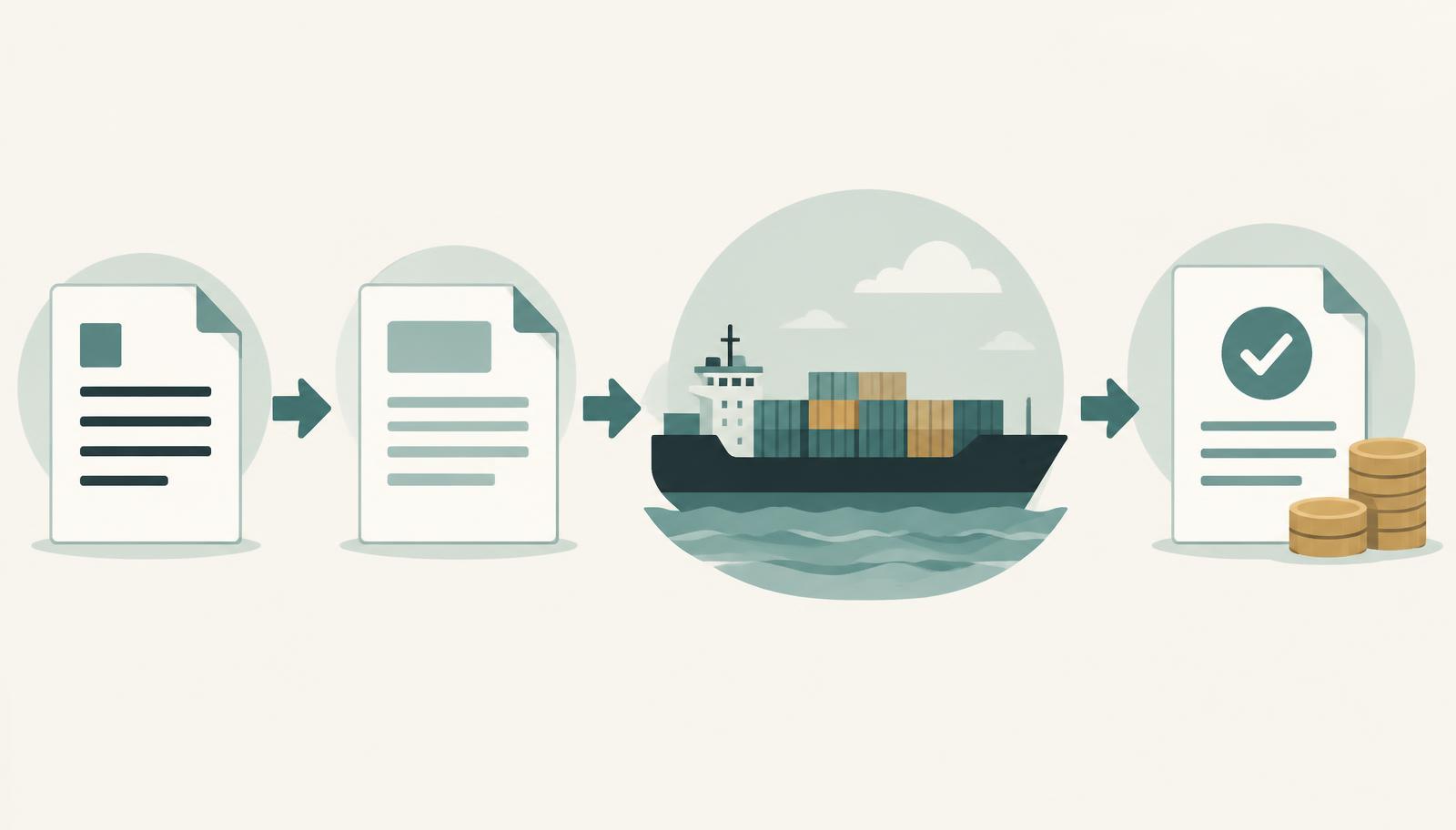
Here's how a typical export order flows from first contact to payment:
- Quote. The buyer asks for pricing; you send a quote.
- Proforma invoice. The buyer accepts. You issue a proforma with exact quantities, Incoterms, and payment terms (e.g. 30% deposit, balance before shipping).
- Deposit or prepayment. The buyer pays against the proforma or opens a letter of credit using it.
- Production and packing. You prepare the goods and a packing list.
- Commercial invoice. On shipment, you issue the commercial invoice — the final values, HS codes, weights — and it travels with the goods.
- Customs clearance. The importer's broker uses the commercial invoice to clear customs and pay duties.
- Reconciliation. You apply the deposit to the final invoice and collect any remaining balance.
For a domestic service business, the flow is shorter: quote → proforma (optional, for a deposit) → standard invoice → payment. If you regularly take deposits, our comparison of 50% upfront, milestones, and retainers helps you choose a structure.
Does a Proforma Invoice Need a Final Invoice?
Yes — always. This is the single most important point in this article. A payment received against a proforma must be followed by a proper invoice. Without it:
- Your client can't reclaim VAT/GST, because a proforma isn't a valid tax invoice.
- Your revenue isn't properly recorded, which distorts reports and can trigger questions in an audit.
- In the UK and EU, receiving an advance payment usually creates a tax point, meaning VAT is due on the amount received — even though no goods have shipped. You'll need to issue a VAT invoice for the deposit within the required time (often 30 days in the UK, and by the 15th of the following month under EU rules in many member states).
In practice, many businesses handle deposits in one of two ways:
- Deposit invoice + final invoice: Issue a real invoice for the deposit when it's received, then a final invoice showing the full total, less the deposit already invoiced.
- Proforma + single final invoice: Where local tax rules allow, collect against the proforma and issue one final invoice that references the prepayment.
Rules differ by country, so confirm the tax point treatment with your accountant — especially if you sell across borders.
Accounting Treatment: Where Each Document Goes
| Event | Document | Bookkeeping entry |
|---|---|---|
| Proforma sent | Proforma invoice | No entry (optionally tracked as a pipeline/sales order) |
| Deposit received against proforma | Receipt (+ deposit invoice where required) | Debit bank, credit customer deposits / deferred revenue (liability) |
| Goods delivered or service completed | Final / commercial invoice | Debit accounts receivable, credit revenue; clear deposit against receivable |
| Balance paid | Receipt | Debit bank, credit accounts receivable |
Confused about the difference between the last two? See invoice vs receipt. And because proformas never enter your receivables, they also never appear in your AR aging report or affect your DSO.
Proforma Invoice Example
Here's what the key section of a proforma might look like for a design agency asking for a 50% deposit:
| Item | Qty | Unit price | Total |
|---|---|---|---|
| Brand identity package (logo, palette, typography) | 1 | $4,000 | $4,000 |
| Website design — 6 page templates | 6 | $500 | $3,000 |
| Subtotal | $7,000 | ||
| Deposit due to start (50%) | $3,500 | ||
Footer text: "PROFORMA INVOICE — PF-0142. This is not a tax invoice. Valid for 30 days. A VAT invoice will be issued on receipt of payment. Work begins once the deposit is received."
Commercial Invoice Example
A small exporter shipping ceramics from Portugal to the US under DAP terms might list:
| Description | HS code | Origin | Qty | Unit value | Total |
|---|---|---|---|---|---|
| Hand-glazed stoneware dinner plates, 27 cm | 6912.00 | Portugal | 200 | €9.50 | €1,900 |
| Stoneware serving bowls, 20 cm | 6912.00 | Portugal | 80 | €14.00 | €1,120 |
| Total invoice value (DAP Chicago) | €3,020 | ||||
Plus: 6 cartons, gross weight 148 kg, net weight 131 kg, reason for export "sale", EORI number, and a signed declaration. HS codes shown are illustrative — always confirm the correct classification with your customs broker or the official tariff database.
Seven Common Mistakes (and How to Avoid Them)
- Not labelling the proforma. Without "Proforma Invoice" at the top, clients' accounts teams may book it as a real invoice — or pay it twice.
- Using your main invoice number series. This creates gaps when proformas don't convert. Use a separate prefix.
- Never issuing the final invoice. The client can't reclaim tax and your books are wrong. Make "convert to invoice" part of your process.
- Charging VAT twice. If you issue a VAT invoice for a deposit, the final invoice should only charge VAT on the remaining balance.
- Vague descriptions on commercial invoices. "Parts" or "gifts" invites inspection and delays.
- Values that don't match the packing list or bill of lading. Inconsistencies are a top cause of customs holds.
- Chasing a proforma as if it were overdue. Since it isn't a debt, sending overdue notices or adding late fees is inappropriate. Follow up politely instead, and save formal reminders for real invoices.
When Should Freelancers and Agencies Use a Proforma?
Service businesses don't ship containers, but proformas are still useful:
- Before starting a project that requires a deposit, especially with new clients.
- For enterprise clients whose procurement system needs a document to create a PO. Pair this with our vendor onboarding checklist.
- For international clients who need proof of cost for their own bank transfer approval.
Make the deposit terms part of your agreement too — our guide to writing a freelance contract that protects payments includes sample clauses.
How to Create Each Document Quickly
You can build all three in the same tool — just change the title, numbering, and fields:
- Proforma: Use our free invoice generator, change the title to "Proforma Invoice", use a PF- reference, add a validity date and a "not a tax invoice" note.
- Standard invoice: Same template with your main number series, supply date, and payment terms such as Net 30.
- Commercial invoice: Add HS codes, origin, weights, Incoterms, and a signed declaration. Many couriers (DHL, FedEx, UPS) also generate one in their shipping portals.
Once the final invoice is out, it's a real receivable — so set up follow-ups. Our reminder schedule builder and reminder email generator help you get paid on time without awkward chasing.
International Rules at a Glance
| Region | Proforma status | Key consideration |
|---|---|---|
| UK | Not a valid VAT invoice | Advance payment usually creates a tax point; issue a VAT invoice (HMRC VAT Notice 700) |
| EU | Not a valid VAT invoice | VAT on advance payments generally chargeable on receipt under the EU VAT invoicing rules |
| US | No federal VAT; informal document | Imports need a commercial invoice meeting CBP requirements |
| Australia | Not a valid tax invoice | GST attributed per accounting basis; see ATO tax invoice guidance |
This table is general information, not tax advice. Always check current rules with a qualified accountant or customs broker.
Key Takeaways
- A proforma invoice is a non-binding pre-bill used for deposits, approvals, and import paperwork.
- A commercial invoice is the binding document customs use for international shipments of goods.
- A standard invoice is the final payment request that creates a receivable and supports tax reporting.
- Every proforma that gets paid needs a proper invoice afterwards.
- Keep proformas in a separate number series and label them clearly.
Frequently Asked Questions
Is a proforma invoice legally binding?
No. A proforma invoice is a preliminary document that shows what the buyer will pay if they confirm the order. It doesn't create a debt. Once the buyer accepts it and you deliver, the final invoice is what's legally binding.
Can I pay or get paid on a proforma invoice?
Yes. Suppliers commonly collect deposits or full prepayment against a proforma. But you must then issue a proper invoice, and in many countries the advance payment triggers VAT or GST.
Is a proforma invoice the same as a commercial invoice?
No. A proforma is sent before a sale is final and can change. A commercial invoice is the final, binding document that goes with a shipment and is used by customs to assess duties.
Do I record a proforma invoice in my accounts?
No. Proformas aren't recorded as sales or receivables. Any payment received against one is usually recorded as a customer deposit (a liability) until the final invoice is issued.
Can a client reclaim VAT on a proforma invoice?
Generally no. In the UK, EU, and Australia a proforma isn't a valid tax invoice. Clients need a proper VAT or tax invoice to reclaim input tax.
Should a proforma invoice have an invoice number?
It should have a reference number, but use a separate series (for example PF-0001) so your main invoice sequence stays continuous with no gaps.
Who issues a commercial invoice — the seller or the buyer?
The seller (exporter) issues the commercial invoice. The buyer or their customs broker uses it to clear the goods and pay any import duties and taxes.
Do service businesses need a commercial invoice?
Usually not. Commercial invoices are for physical goods crossing borders. Service businesses use standard invoices, even for international clients.
How long is a proforma invoice valid?
As long as you say it is. Most businesses state a validity period of 15–30 days, since prices, exchange rates, and shipping costs can change.
What's the difference between a proforma invoice and a quote?
A quote is a price offer while the client is still deciding. A proforma is more detailed, mirrors the final invoice, and is typically used once the client has agreed, so they can pay a deposit or get internal approval.
Can a proforma invoice be used for customs?
Sometimes. Customs may accept a proforma for samples, free-of-charge items, or pre-clearance when the final value isn't known yet. For a normal sale, a commercial invoice is required.