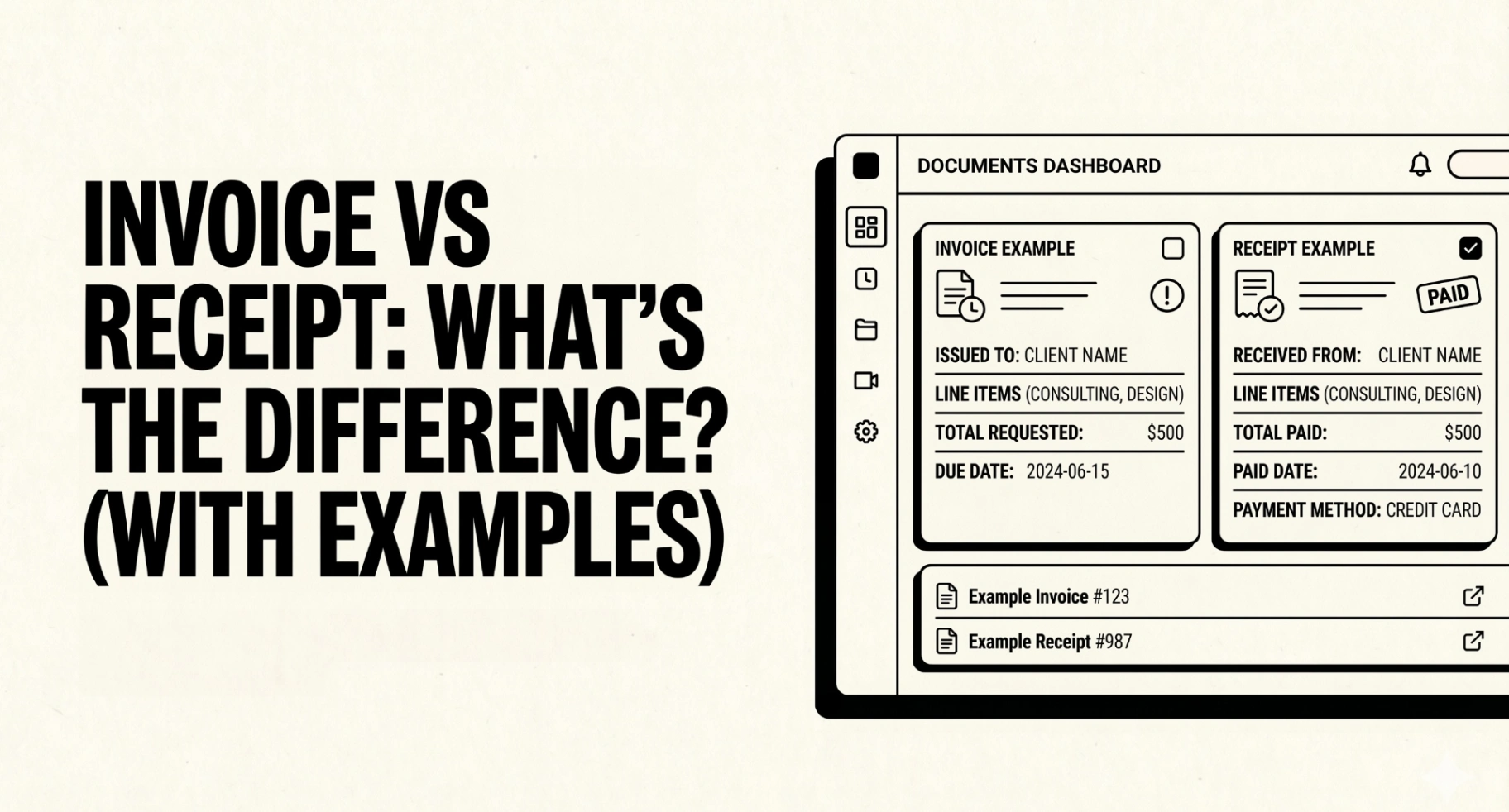
Invoice vs Receipt: What's the Difference? (With Examples)
If you've ever wondered whether to send a client an invoice or a receipt, you're not alone. These two documents look similar, serve related purposes, and are often confused — even by experienced business owners.
But here's the thing: invoices and receipts are fundamentally different documents. Mixing them up can create accounting headaches, tax filing errors, and awkward client conversations.
In this guide, we'll break down exactly what each document is, when to use it, what to include, and how they fit into your payment workflow. We'll also show you real-world examples and answer the most common questions freelancers and small business owners ask about invoices vs receipts.
What Is an Invoice?
An invoice is a formal payment request sent by a seller to a buyer. It says: "Here's what you owe, and here's when it's due."
Invoices are sent before payment is made. They outline the products or services delivered, the total amount due, the payment terms (like Net 30 or due on receipt), and instructions for how to pay.
Key Elements of an Invoice
A professional invoice typically includes:
Need a deeper walkthrough? Check out our step-by-step guide to creating an invoice.
When Do You Send an Invoice?
You send an invoice when:
In short, invoices are your primary tool for requesting payment from clients.
What Is a Receipt?
A receipt is a document that confirms payment has been made. It says: "Payment received — here's your proof."
Receipts are issued after payment. They serve as proof of transaction for the buyer and help both parties with record-keeping, tax deductions, and accounting.
Key Elements of a Receipt
A standard receipt includes:
When Do You Issue a Receipt?
You issue a receipt when:
Invoice vs Receipt: Key Differences at a Glance
Here's a side-by-side comparison of the two documents:
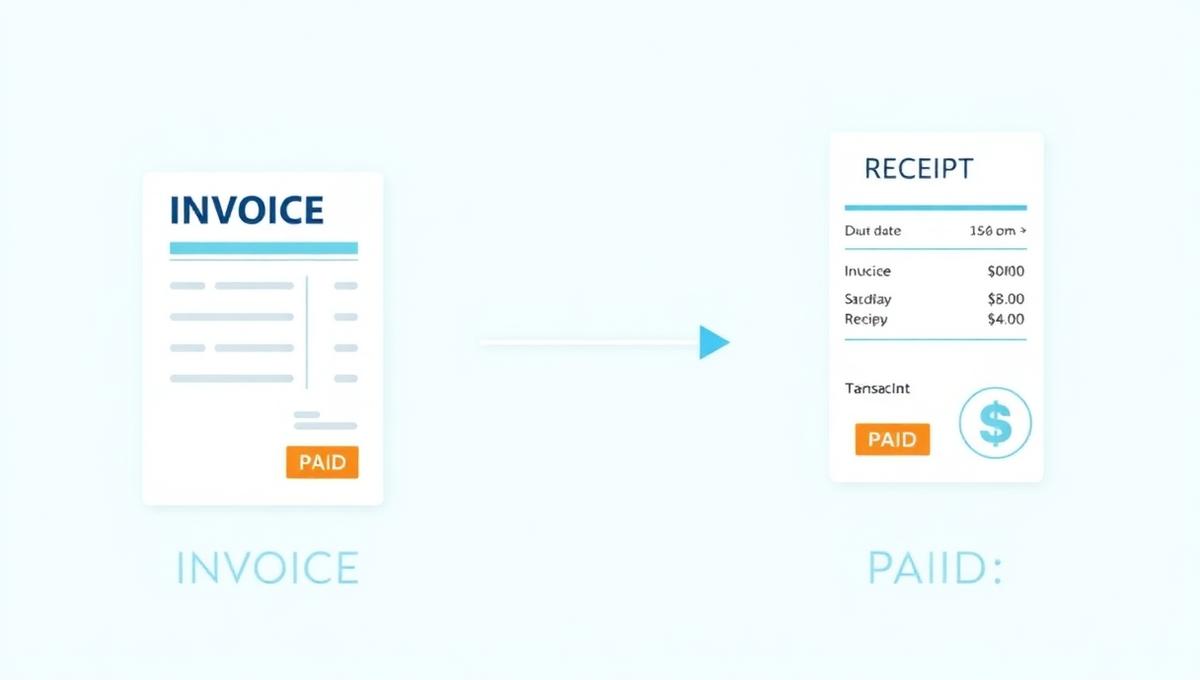
How Invoices and Receipts Fit Together in the Payment Workflow
Understanding the relationship between invoices and receipts is crucial. Here's how they fit into a typical B2B or freelance payment cycle:
- You complete the work — Project, milestone, or deliverable is done
- You send an invoice — With clear details, amount, and payment terms
- You follow up if needed — Using polite payment reminders
- Client pays the invoice — Via bank transfer, credit card, or another method
- You issue a receipt — Confirming payment received
- Both parties file the documents — For tax and accounting purposes
Some invoicing tools like Can You Pay That automatically mark invoices as "Paid" when payment is received, which can serve as a de facto receipt in many cases.
Real-World Examples: Invoice vs Receipt
Example 1: Freelance Web Designer
Sarah is a freelance web designer. She completes a website redesign for a client and sends an invoice:
Once Acme pays on April 18, Sarah issues a receipt:
Example 2: Small Retail Business
In retail, the process is often reversed. A customer walks into a shop, buys a product, and receives a receipt immediately — no invoice is needed because payment happens at the point of sale.
This is why receipts are more common in B2C (business-to-consumer) transactions, while invoices are essential in B2B (business-to-business) transactions where payment terms and credit are involved.
5 Common Mistakes When Using Invoices and Receipts
1. Sending a Receipt Instead of an Invoice
This is the most common mix-up. If you send a receipt before payment, you're essentially telling the client they've already paid — even though they haven't. This can delay payment significantly and create confusion in your financial reporting.
2. Not Issuing Receipts at All
Some freelancers skip receipts entirely, relying on bank statements as proof of payment. While bank statements work in a pinch, proper receipts are better for:
3. Using the Same Number for Both
Invoices and receipts should have separate numbering systems. Using "INV-1001" for your invoice and "REC-1001" (or "R-1001") for the corresponding receipt keeps your records clean and auditable.
4. Missing Key Details on Either Document
An invoice without a due date isn't really an invoice. A receipt without a payment date isn't really a receipt. Make sure each document includes all the required elements to be legally and professionally valid.
5. Not Keeping Copies
Both invoices and receipts should be stored for at least 3–7 years (depending on your jurisdiction) for tax purposes. Using invoicing software that automatically archives documents saves you from this headache.
Do You Always Need Both an Invoice and a Receipt?
It depends on your business model:
For freelancers and agencies: You should always send an invoice before payment and ideally issue a receipt (or mark the invoice as "Paid") after payment. This creates a clean paper trail for both you and your client.
Invoice vs Receipt for Tax Purposes
Both documents play important roles at tax time, but they serve different functions:
Invoices for Tax
Receipts for Tax
Pro tip: If you're a freelancer, keep both your outgoing invoices (income) and incoming receipts (expenses) organized by month. This makes tax season dramatically less painful.
Can an Invoice Serve as a Receipt?
Technically, no — an unpaid invoice is not proof of payment. However, a "Paid" invoice (an invoice marked as paid with the payment date and method noted) can function similarly to a receipt in many practical scenarios.
Many modern invoicing tools — including Can You Pay That — let you mark invoices as "Paid" and automatically record the payment date. This creates a combined document that works for both accounting and tax purposes.
That said, in some jurisdictions and for certain tax compliance scenarios (especially with VAT), you may be legally required to issue a separate receipt. Always check your local regulations.
Other Related Financial Documents You Should Know
Invoices and receipts are just two documents in a broader financial ecosystem. Here are others you might encounter:
Understanding these documents and when to use each helps you run a tighter operation and avoid the kind of confusion that leads to late payments.
Tips for Managing Invoices and Receipts Efficiently
- Use invoicing software — Tools like Can You Pay That handle both invoicing and payment tracking in one place
- Set up automatic reminders — Use a reminder schedule to follow up on unpaid invoices without manual effort
- Create templates — Use consistent invoice templates so every document looks professional
- Protect yourself with contracts — A solid freelance contract that specifies invoicing and receipt procedures prevents disputes
- Keep digital copies — Store all invoices and receipts digitally for easy retrieval during tax season
- Separate numbering — Use distinct prefixes (INV- for invoices, REC- for receipts) to avoid confusion
Frequently Asked Questions
Is an invoice the same as a receipt?
No. An invoice is a payment request sent before payment, while a receipt is a confirmation issued after payment has been received. They serve different purposes in the financial workflow.
Can I use an invoice as proof of payment?
An unpaid invoice is not proof of payment. However, an invoice marked as "Paid" with the payment date and method can serve as proof in many practical scenarios. For strict tax compliance, a separate receipt is recommended.
Do freelancers need to issue receipts?
While not always legally required, issuing receipts is a best practice for freelancers. It builds client trust, creates a clean paper trail, and helps both parties during tax season.
When should I send an invoice vs a receipt?
Send an invoice when you want to request payment for completed work. Issue a receipt after you've received payment to confirm the transaction.
Do I need both an invoice and a receipt for every transaction?
For B2B transactions (freelancing, agencies, professional services), yes — you should ideally have both. For simple retail or point-of-sale transactions, a receipt alone is usually sufficient.
What's the difference between a receipt and a bill?
A bill is essentially another word for an invoice — it's a request for payment. A receipt confirms that payment has been made. In restaurants, the "bill" is what you receive before paying; the receipt is what you get after.
Are invoices legally required?
In many jurisdictions, invoices are legally required for B2B transactions, especially for VAT/GST purposes. Even where not legally mandated, they're essential for proper bookkeeping and getting paid on time.
How long should I keep invoices and receipts?
Most tax authorities recommend keeping financial records for 3 to 7 years. In the US, the IRS generally recommends 3 years for income records and 7 years if you've claimed a loss. Always check your local regulations.