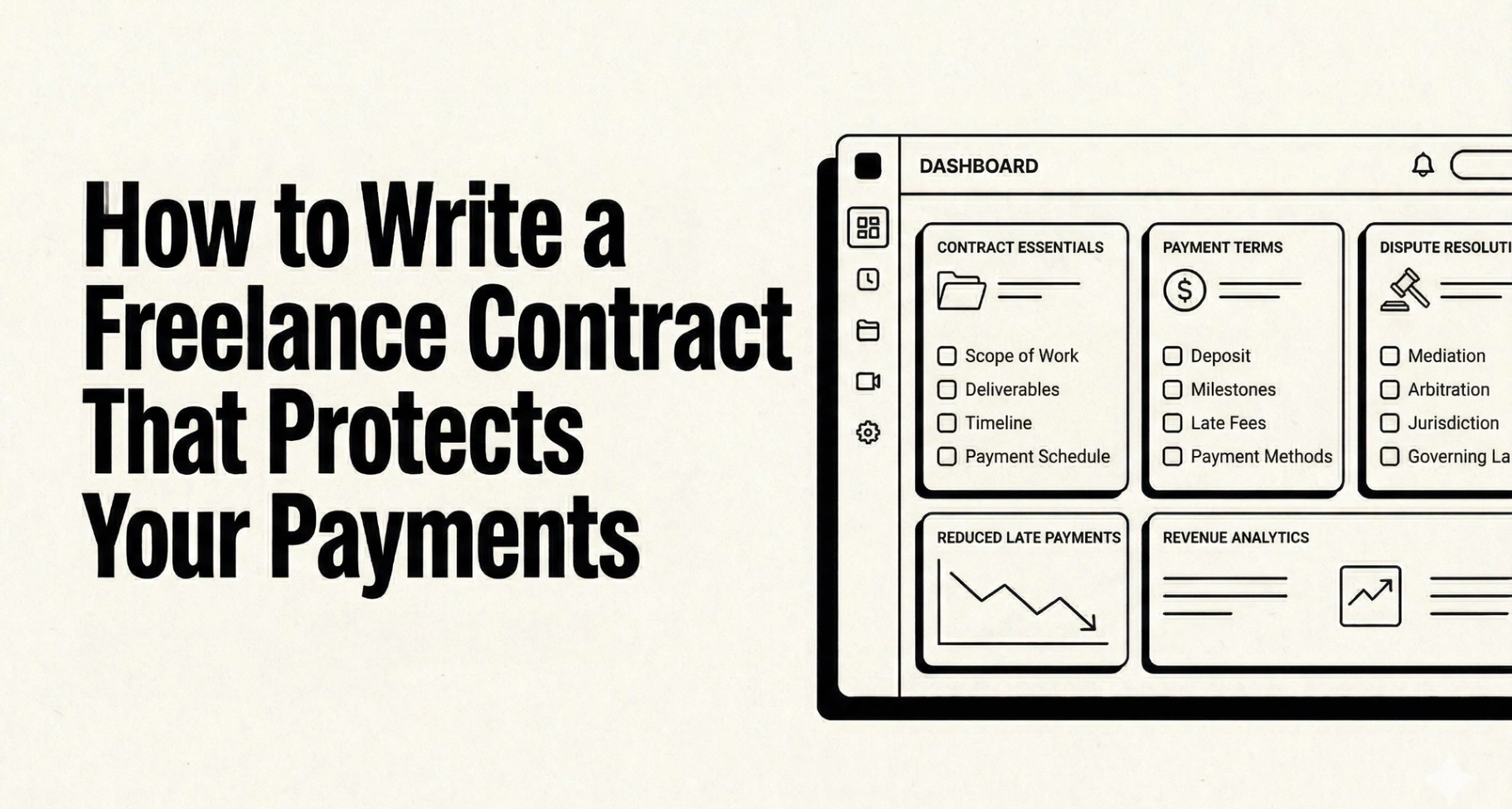
How to Write a Freelance Contract That Protects Your Payments (Template + Checklist)
Getting stiffed on a project is every freelancer''s nightmare. You deliver the work, send the invoice, and then… silence. Weeks go by. The client ghosts you. And you realize you never had a proper contract in place.
According to a Freelancers Union survey, 71% of freelancers have struggled to collect payment at some point in their career. The single most effective way to prevent this? A well-written freelance contract with airtight payment terms.
In this guide, you''ll learn exactly how to write a freelance contract that protects your payments — with real clause examples, a downloadable checklist, and practical tips from freelancers who''ve been in the trenches.

Why Every Freelancer Needs a Written Contract
Let''s be honest: many freelancers — especially those just starting out — skip the contract entirely. They rely on email threads, verbal agreements, or "trust." Here''s why that''s a costly mistake:
Bottom line: A freelance contract isn''t just paperwork — it''s your most important business tool for getting paid.
7 Essential Clauses Every Freelance Contract Must Include
Not all contracts are created equal. A generic template you downloaded from the internet might miss critical clauses that protect your payments. Here are the seven non-negotiable sections:
1. Scope of Work (SOW)
This is the backbone of your contract. The scope of work defines exactly what you''re delivering, in what format, and by when.
What to include:
Example clause:
"Contractor will design and develop a 5-page responsive website (Home, About, Services, Blog, Contact) using WordPress. The project includes up to 2 rounds of revisions per page. Additional pages, custom plugin development, and ongoing maintenance are not included in this scope and will be quoted separately."
Pro tip: The more specific your SOW, the harder it is for clients to demand extra work without extra pay. Be detailed — it protects both parties.
2. Payment Terms & Schedule
This is where most freelancers either get it right or set themselves up for payment problems. Your payment terms should leave zero room for interpretation.
What to include:
Example clause:
"The total project fee is $5,000 USD, payable as follows: 50% ($2,500) due upon contract signing before work begins; 25% ($1,250) due upon delivery of the first draft; 25% ($1,250) due upon final delivery. All invoices are payable within 15 days of receipt via bank transfer or credit card."
Need help structuring your payment milestones? Our guide on choosing between upfront payments, milestones, and retainers breaks down the pros and cons of each approach.
3. Late Payment Penalties
Here''s a hard truth: if there''s no consequence for paying late, some clients will always pay late. A late payment clause adds teeth to your invoice due dates.
Example clause:
"Invoices not paid within the agreed payment period will incur a late fee of 1.5% per month (18% annually) on the outstanding balance. If payment is more than 30 days overdue, Contractor reserves the right to pause all work and withhold deliverables until the account is brought current."
Use our free Late Payment Fee Calculator to determine the right penalty rate for your contracts.
For tips on following up when invoices go past due, see our guide to asking for payment politely — with 12 ready-to-use email templates.
4. Kill Fee (Cancellation Clause)
What happens if the client cancels the project halfway through? Without a kill fee clause, you could lose weeks of work with nothing to show for it.
Example clause:
"If Client terminates this agreement before project completion, Client agrees to pay for all work completed to date plus a cancellation fee of 25% of the remaining project balance. All deposits are non-refundable. Contractor will deliver all completed work within 5 business days of receiving final payment."
Why this matters: Freelancers often turn down other work to commit to a project. A kill fee compensates for the opportunity cost of that commitment.
5. Intellectual Property & Ownership Transfer
Who owns the work? This question has caused countless disputes. Be crystal clear about when ownership transfers.
Example clause:
"Upon receipt of full and final payment, Contractor assigns all intellectual property rights in the deliverables to Client. Until full payment is received, all work product remains the exclusive property of Contractor. Contractor retains the right to display the work in their portfolio."
Key principle: Tie ownership transfer to payment completion. This gives you leverage if the client tries to use your work without paying.
6. Revision Policy
Unlimited revisions are a recipe for disaster. Define how many rounds of revisions are included and what happens after that.
Example clause:
"This agreement includes 2 rounds of revisions per deliverable. A ''revision round'' is defined as a single set of consolidated feedback provided within 5 business days of delivery. Additional revision rounds will be billed at $150/hour. Revisions requested more than 30 days after delivery constitute new work and will be quoted separately."
7. Dispute Resolution
No one wants to think about disputes, but having a resolution process in writing prevents costly courtroom battles.
Example clause:
"Any disputes arising from this agreement shall first be addressed through good-faith negotiation between the parties. If the dispute cannot be resolved within 30 days, the parties agree to submit to binding mediation in [your city/state]. The prevailing party shall be entitled to recover reasonable legal fees."
Freelance Contract Checklist: 7 Items to Verify Before Signing
Before you send your contract to the client, run through this checklist to make sure nothing critical is missing:
- Scope of work is specific and measurable — no vague language like "design work" or "as needed"
- Payment amount, schedule, and method are clearly stated — including currency and due dates
- Late payment penalties are defined — with specific percentages and timelines
- Kill fee / cancellation terms are included — protecting you if the project is cancelled
- IP ownership transfer is tied to full payment — you retain rights until paid
- Revision limits are set — with pricing for additional rounds
- Both parties have signed and dated the document — digital signatures (DocuSign, HelloSign) are legally valid
Bonus item: Include a "right to pause" clause that lets you stop work if an invoice goes more than 14 days overdue. This is your safety net. For a template on how to communicate a work pause, read our Pause Work Until Paid email template guide.
Payment Structures for Freelance Contracts: Which One Protects You Best?
The right payment structure depends on your project type, client relationship, and risk tolerance. Here''s a comparison:
Our recommendation: For most freelancers, the 50/50 split or milestone-based approach offers the best balance of client trust and payment protection. Never start work without at least a 25–50% deposit.
Read our in-depth comparison: 50% Upfront, Milestones, or Monthly Retainers — What Gets Agencies Paid Faster?
5 Client Red Flags During Contract Negotiation
Your contract protects you — but sometimes the warning signs appear before the contract is even signed. Watch out for these red flags:
- "We don''t usually do contracts" — Any legitimate business uses contracts. This is a major warning sign.
- "Can we skip the deposit and pay everything at the end?" — This shifts all financial risk onto you. Counter-offer with a smaller deposit (never zero).
- "Our legal team needs to remove the late fee clause" — They''re telling you they plan to pay late. Stand firm on this clause.
- "We''ll figure out the exact scope as we go" — This is scope creep waiting to happen. Insist on at least a high-level SOW.
- They pressure you to start immediately before signing — Never begin work without a signed agreement. "I''d love to start right away — once we have the signed contract and deposit, I''ll begin within 24 hours."
How to Enforce Your Contract Terms with Invoice Automation
A great contract is only as good as its enforcement. Here''s where most freelancers drop the ball: they write solid contracts but then fail to follow through on payment collection.
The solution? Automate your invoicing and follow-up process:
With CanYouPayThat, you can automate your entire accounts receivable workflow — from sending invoices to following up on overdue payments — so your contract terms are always enforced without awkward manual follow-ups.
Free Freelance Contract Template (Key Payment Clauses)
Here''s a simplified freelance contract template focused on payment protection. Customize it for your specific needs:
FREELANCE SERVICE AGREEMENT
Between: [Your Name/Business] ("Contractor") and [Client Name/Business] ("Client")
Effective Date: [Date]
Project: [Brief project description]
1. SCOPE OF WORK Contractor agrees to deliver: [list specific deliverables]. This project includes [X] rounds of revisions. Additional work will be quoted separately.
2. COMPENSATION Total fee: $[amount] [currency]. Payment schedule: [50% upon signing / 50% upon completion]. All invoices payable within [15] days via [bank transfer / credit card].
3. LATE PAYMENT Invoices unpaid after the due date will incur a late fee of [1.5%] per month. Work will be paused if any invoice remains unpaid for more than [14] days.
4. CANCELLATION If Client cancels, Client pays for all completed work plus [25%] of the remaining balance. All deposits are non-refundable.
5. INTELLECTUAL PROPERTY All rights transfer to Client upon receipt of full payment. Until then, all work remains Contractor''s property.
6. DISPUTE RESOLUTION Disputes will be resolved through mediation in [jurisdiction]. The prevailing party recovers legal fees.
Agreed and signed:
Contractor: _________________ Date: _________
Client: _________________ Date: _________
Important: This template covers the essentials, but we recommend having a lawyer review your contract, especially for high-value projects. Laws vary by jurisdiction, and a legal professional can ensure your contract is enforceable in your area.
5 Common Freelance Contract Mistakes That Cost You Money
Even experienced freelancers make these contract mistakes. Avoid them to protect your bottom line:
- Using vague scope descriptions — "Design services" could mean anything. Be specific about deliverables, timelines, and quantities.
- Not requiring a deposit — Starting work without payment is a trust exercise you can''t afford. Always collect 25–50% upfront.
- Forgetting to include a kill fee — Projects get cancelled. Without a kill fee, you absorb the entire cost of lost time and opportunity.
- Setting unreasonable payment terms — Net 60 or Net 90 terms are cash flow killers for freelancers. Aim for Net 15 or Net 30 at most.
- Not specifying when IP transfers — If you don''t state that ownership transfers upon full payment, a client might argue they own the work after the first milestone payment.
Digital Tools to Streamline Your Contract-to-Payment Workflow
Modern freelancers don''t need to manage contracts and payments manually. Here''s a recommended tech stack:
Contract Tips by Industry
While the core contract principles apply universally, certain industries have specific considerations:
Web Design & Development
Copywriting & Content Creation
Graphic Design & Branding
Consulting & Strategy
Frequently Asked Questions About Freelance Contracts
Do I need a lawyer to write a freelance contract?
For most standard freelance projects, a well-crafted template is sufficient. However, for high-value contracts (over $10,000), international clients, or projects involving sensitive intellectual property, investing in legal review is worth it. Many lawyers offer flat-rate contract reviews for $200–$500.
Is a digital contract legally binding?
Yes. In the United States, the E-SIGN Act and the Uniform Electronic Transactions Act (UETA) make electronic signatures and digital contracts legally enforceable. Similar laws exist in the EU (eIDAS), UK, Canada, and Australia.
What should I do if a client refuses to sign a contract?
Walk away. A client who refuses to formalize the agreement is a client who doesn''t respect your business. At minimum, send a detailed email outlining the scope, payment terms, and timeline, and ask for written confirmation — this creates a paper trail that can serve as an informal agreement.
How much should I charge as a deposit?
Industry standard is 25–50% of the total project fee. For new clients or high-risk projects, lean toward 50%. For established relationships, 25% is often sufficient. Some freelancers charge 100% upfront for small projects under $1,000.
Can I charge late fees if they weren''t in the original contract?
Generally, no. Late fees should be agreed upon in advance and included in the signed contract. Retroactively adding penalties is usually not enforceable. This is why it''s critical to include a late payment clause from the start.
What''s the best payment term for freelancers?
Net 15 is ideal for most freelancers — it''s short enough to maintain healthy cash flow but gives clients enough time to process payment. Net 30 is acceptable for larger corporate clients. Avoid Net 60 or Net 90 unless you have strong cash reserves. Learn more in our guide on reducing late payments from clients.
Should I include a non-compete clause in my freelance contract?
Be cautious with non-competes. As a freelancer, agreeing not to work with competing clients can severely limit your income. If a client insists, make sure it''s narrowly scoped (specific competitors, limited timeframe) and that you''re compensated for the restriction.
What happens if a client disputes the quality of my work?
This is where your scope of work and revision policy clauses become critical. If you delivered what was specified in the contract and the client approved the milestones, you have strong grounds. Document everything — approvals, feedback, and communications. Your dispute resolution clause provides the framework for handling this.
Protect Your Payments: Start With the Contract
A freelance contract isn''t just legal protection — it''s a business tool that sets expectations, prevents disputes, and ensures you get paid for your work. Every clause, from scope of work to late payment penalties, works together to create a system that protects your income.
Here''s your action plan:
- Use the template and checklist in this guide to draft your standard contract
- Customize the payment terms to match your business model
- Never start work without a signed contract and deposit
- Automate your invoicing and payment follow-up with CanYouPayThat
- Review and update your contract annually as your business evolves
Ready to create professional invoices that match your new contract? Try our free invoice generator — no signup required.