Invoice Disputes: How to Handle a Client Who Disputes an Invoice
A disputed invoice is not the same as a late invoice, and treating it like one is the single fastest way to turn a solvable billing question into a write-off. When a client says "we're not paying this", the clock on your cash stops, your reminder sequence becomes counterproductive, and the burden of proof quietly shifts to you. This guide covers what counts as an invoice dispute, the legal and practical position in the UK, EU, US and Australia, a five-stage resolution process, the exact emails to send at each stage, when to issue a credit note instead of arguing, and how to design your invoicing so most disputes never happen.
Quick Answer: What Is an Invoice Dispute?
An invoice dispute is a formal objection by a customer to all or part of an invoice — on grounds of price, quantity, quality, scope, duplication, or missing documentation — which suspends the expectation of payment on the disputed amount until it is resolved. Best practice is to acknowledge within one business day, require the objection in writing with specifics, pause automated reminders on that invoice only, keep undisputed amounts payable on their original due date, and resolve with either evidence, a credit note, or a revised invoice within 10 business days.
Dispute vs Late Payment vs Excuse
These three look identical in your accounting system — all you see is an unpaid balance past its due date. They need completely different responses.
| Situation | What the client is saying | Correct response |
|---|---|---|
| Late payment | "We owe it, we haven't paid yet." | Continue your reminder cadence; apply late fees if agreed. |
| Genuine dispute | "We don't owe this amount, for this reason." | Pause reminders, investigate, resolve in writing within a fixed window. |
| Stalling excuse | "Accounts is looking into it" / "we never got it". | Treat as late payment; re-send with proof of delivery and a firm date. |
The distinguishing test is simple: a genuine dispute is specific. It names a line item, a quantity, a rate, a date, or a deliverable. Anything vague — "there's a problem with the invoice", "we're reviewing it", "cash flow is tight this month" — is not a dispute and should not stop your automated reminders. Ask one question to find out which you are dealing with: "Which line item and what amount is in question?" A client with a real objection answers in a sentence. A client who is stalling changes the subject.
Why Disputes Cost More Than Late Payments
Late invoices get paid eventually. Disputed invoices are where receivables go to die. Three reasons:
- They age silently. A disputed invoice sits in your AR aging report looking like ordinary 60-day debt, so it never triggers escalation.
- Evidence decays. Timesheets, approval emails and delivery confirmations are easy to produce in week one and very hard to reconstruct in month four.
- They spread. Once one invoice is "under query", clients frequently hold the next one too, on the same account.
Industry collections data consistently shows that a disputed balance resolved within 10 days is paid in the overwhelming majority of cases, while one left open past 90 days converts to bad debt at a far higher rate. Speed, not argument quality, is the variable you control. That is also why disputes distort your DSO more than anything else: a handful of stuck invoices can add a week to a portfolio metric that otherwise looks healthy.
The Seven Causes of Invoice Disputes
Almost every dispute you will ever receive falls into one of these categories. Knowing which one you are in tells you what evidence to gather before you reply.
| Cause | Typical wording | Evidence that resolves it |
|---|---|---|
| Price / rate mismatch | "This was quoted at a lower rate." | Signed quote, SOW, rate card, rate-change email. |
| Quantity or hours | "We were billed 40 hours, we expected 30." | Timesheets, task logs, weekly status reports. |
| Scope creep | "We never approved this extra work." | Written change request and approval. |
| Quality / non-delivery | "The work isn't finished / isn't right." | Acceptance criteria, sign-off, delivery timestamps. |
| Admin error | "Wrong PO number / wrong entity / wrong tax." | Corrected invoice — your error, fix it fast. |
| Duplicate billing | "We've already paid this." | Bank reference, remittance advice, statement of account. |
| Process / compliance | "Not submitted through our portal." | Vendor requirements — resubmit correctly. |
Note how many are administrative rather than substantive. In most small-business receivables ledgers, the majority of disputes are missing PO numbers, wrong billing entity, or portal submission failures — problems that cost nothing to fix but weeks of cash if nobody notices. A solid vendor onboarding checklist eliminates most of them before the first invoice goes out.
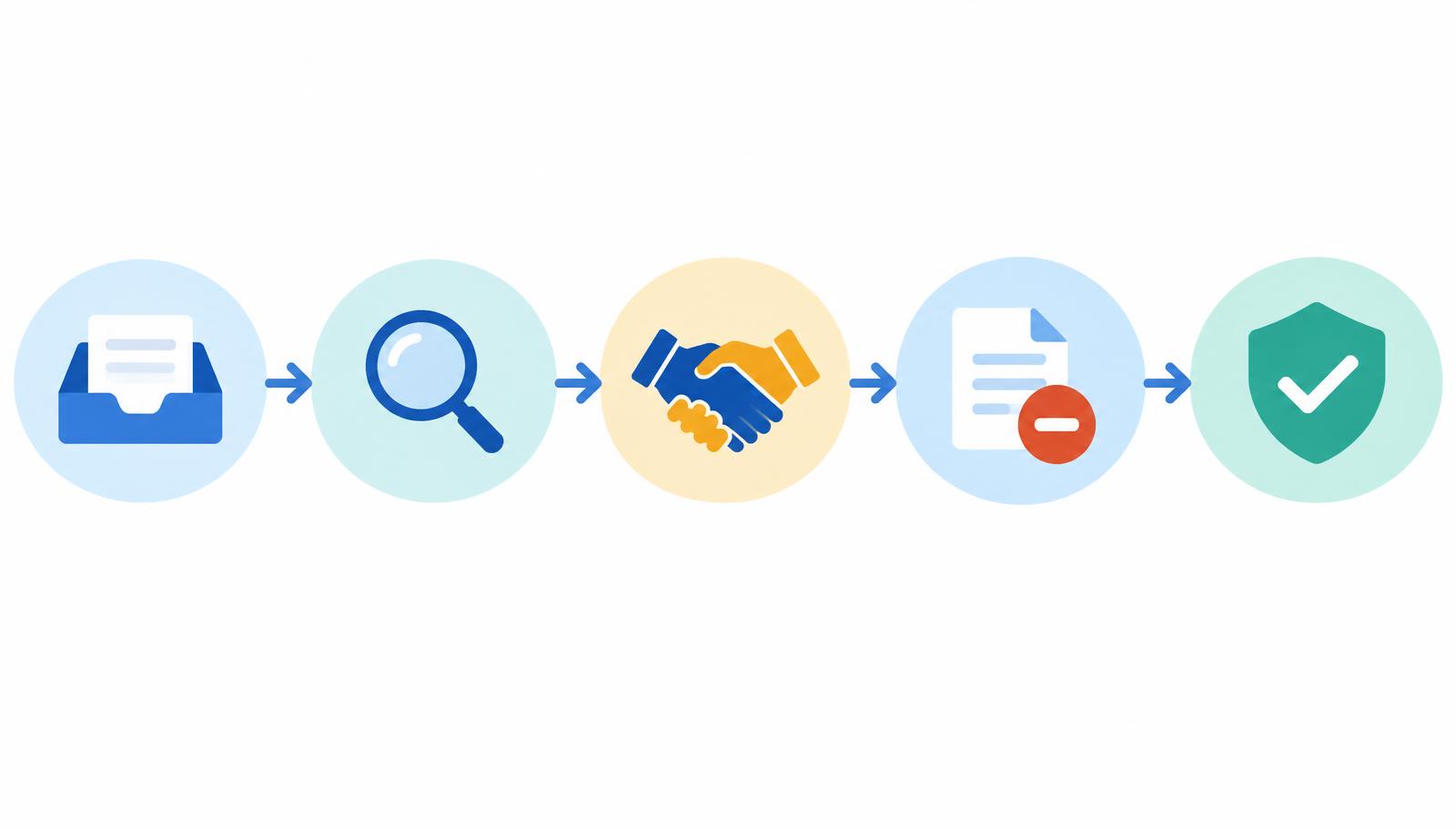
The Five-Stage Dispute Resolution Process
Stage 1 — Acknowledge within one business day
Speed of acknowledgement is the strongest signal you can send that this will be handled professionally rather than fought. Your acknowledgement does three jobs: it confirms receipt, it converts a vague complaint into a specific one, and it protects the undisputed balance.
Critically, split the invoice in your own mind immediately. If a £9,000 invoice is disputed over a £600 line, £8,400 is still due on the original date. Say so, politely, in the first reply. Clients rarely object, and it keeps the bulk of the cash moving.
Stage 2 — Investigate against the paper trail, not memory
Set an internal deadline of three business days. Pull the contract or SOW, the approved quote, the change requests, the delivery evidence, and the invoice itself. Establish one of three conclusions:
- We are right and can prove it — proceed to evidence-based response.
- They are right — issue a credit note or corrected invoice immediately and without drama.
- It is ambiguous — the contract is silent, or the approval was verbal. This is the commercial judgment case, and you should decide based on the value of the relationship, not the principle.
Be genuinely honest at this stage. Defending an invoice you know is shaky costs more in relationship equity than the amount in question, and it makes your next dispute harder to win.
Stage 3 — Respond with evidence and a proposed resolution
Never respond with evidence alone. Every response should attach documents and propose a specific outcome with a date: "Here are the approved timesheets. On that basis the invoice stands as issued — can you confirm payment on Friday the 14th?" Ending with a question and a date is what converts a reply into a resolution.
Stage 4 — Adjust formally, never informally
If you concede anything — a reduced rate, hours written off, a goodwill discount — document it with a credit note, not an email saying "just pay the lower amount". A credit note keeps your ledger, your tax records and your audit trail consistent, and it gives the client's accounts payable team the document they need to release payment.
Stage 5 — Close the loop and restart the clock
When the dispute resolves, do three things in the same message: confirm the agreed amount, confirm the new payment date, and confirm that reminders resume from that date. Then actually restart them. Resolved-but-forgotten is the most common way a dispute becomes a write-off.
Email Templates for Each Stage
These follow the same tone principles as our polite payment request templates — neutral, specific, and always ending with a date.
Template 1: Acknowledging a dispute
Subject: Invoice INV-1042 — query received, response by Thursday
Hi [Name],
Thanks for flagging this — I'd rather sort it out now than have it sit unpaid.
So I can look into the right thing: which line item and what amount are you querying? If it's the [design hours] line, I'll pull the approved timesheets and come back to you by Thursday 14th at the latest.
In the meantime, the undisputed balance of £8,400 remains due on the original date of the 10th. That keeps the query from holding up the rest of the invoice.
Best,
[You]
Template 2: Responding with evidence (invoice stands)
Subject: Invoice INV-1042 — timesheets attached, confirming amount
Hi [Name],
I've reviewed the query on the additional 10 hours. Attached are the weekly timesheets and the change request you approved by email on 3 March, which covers the extra scope.
On that basis the invoice is correct as issued at £9,000. Can you confirm payment on Friday 14th? If anything in the attachments doesn't match your records, tell me which entry and I'll go back through it.
Best,
[You]
Template 3: Partial concession with a credit note
Subject: Invoice INV-1042 — credit note CN-0087 issued, revised total £8,600
Hi [Name],
You were right about the two hours on the 6th — those were logged to the wrong project. I've issued credit note CN-0087 for £400, which brings the invoice to £8,600.
The rest of the invoice is supported by the approved change request (attached). Please treat £8,600 as due on Friday 14th and let me know if you need the credit note in any particular format for your system.
Best,
[You]
Template 4: Dispute used as a stalling tactic
Subject: Invoice INV-1042 — no details received, payment now 34 days overdue
Hi [Name],
I've asked twice (on the 12th and 19th) for the specific line item in question and haven't had details back. Without them I can't investigate anything.
Unless I receive the specifics by close of business Thursday 20th, I'll treat the invoice as undisputed and payable in full at £9,000, and it will return to our standard overdue process, including statutory interest from the original due date.
I'd much rather resolve a real query than escalate an administrative one — so if there is a genuine issue, send it over today.
Best,
[You]
If you reach this point, the tone guidance in our second notice template and the escalation rules in pausing work until paid apply from here on.
Credit Notes: The Right Way to Concede
A credit note (also called a credit memo) is a document that reduces the amount owed on a previously issued invoice. It does not delete the original invoice — that is the whole point. In most tax regimes, including UK VAT and EU VAT rules, once an invoice has been issued you cannot simply amend or destroy it; you must issue a credit note that references it.
| Scenario | Use | Why |
|---|---|---|
| Agreed reduction after dispute | Credit note | Preserves audit trail and VAT treatment. |
| Wrong client entity or tax number | Full credit note + new invoice | The original is legally defective. |
| Invoice sent in error / duplicate | Full credit note | Cancels the liability cleanly. |
| Typo in description only | Corrected invoice, same number | No change to the amount owed. |
| Client simply won't pay | Bad debt write-off, not a credit note | Different accounting and tax treatment. |
That last row matters more than it looks. A credit note says the amount was never properly owed. A bad debt write-off says it was owed and we couldn't collect. Conflating them understates your revenue and can cost you legitimate VAT bad-debt relief. A valid credit note should carry its own sequential number (following the same rules as your invoice numbering system), the date of issue, a reference to the original invoice number, the reason for the credit, and the tax breakdown mirroring the original.
Where You Stand Legally
Rules vary, but the direction of travel is consistent: a genuine dispute suspends interest on the disputed portion only, and a bad-faith dispute suspends nothing.
- United Kingdom. Under the Late Payment of Commercial Debts (Interest) Act 1998, statutory interest runs on a "qualifying debt". Where a debt is genuinely disputed, interest on that portion is typically deferred until resolution, but the undisputed remainder continues to accrue interest and fixed compensation from its original due date.
- European Union. The Late Payment Directive works on the same principle — the creditor is entitled to interest and €40 compensation where they have fulfilled their obligations and are not responsible for the delay. A dispute that is substantiated changes that; one that is not, does not.
- United States. Purely contractual. Whatever your terms say about disputes governs: most well-drafted terms require written notice within a fixed window (commonly 7–14 days of invoice receipt) and deem the invoice accepted if no notice arrives.
- Australia and Canada. Also contract-led, with unfair-contract-terms legislation in Australia meaning dispute windows must be reasonable and clearly communicated, not buried.
The practical takeaway is universal: write a dispute window into your terms. Without one, a client can raise an objection in month three that would have been trivial to resolve in week one. For how interest itself is calculated once a dispute clears, see our guide to late payment fees and interest.
Contract clause you can copy
"The Client must notify the Supplier in writing of any dispute regarding an invoice within 10 business days of receipt, specifying the line items and amounts in question and the grounds for the dispute. Invoices not disputed within this period are deemed accepted. Any undisputed portion of a disputed invoice remains payable by the original due date. The parties will use reasonable efforts to resolve a notified dispute within 15 business days, after which unresolved amounts become immediately payable unless otherwise agreed in writing."
Pair it with a short line in your invoice footer: "Queries must be raised in writing within 10 business days of receipt. Undisputed amounts remain payable on the due date." You can set this once as a default note in the free invoice generator so it appears on every invoice without you thinking about it.
Pausing Reminders Without Losing the Invoice
Sending an automated "your invoice is overdue" email to a client who raised a legitimate query two days ago is the fastest way to make a small dispute personal. But switching reminders off entirely is how invoices disappear for six months. The workable middle ground:
- Pause the automated cadence on that invoice only — not the client's other invoices.
- Set an explicit review date, usually 7–10 business days out, tied to the resolution deadline you promised.
- Auto-resume on that date if the dispute is not closed, with a message that references the dispute rather than ignoring it.
- Keep the invoice visible in a dedicated "disputed" state in your aging review, so it is reported on weekly rather than hidden.
This is exactly how the dispute and pause states in Can You Pay That's collections inbox work: marking an invoice disputed suspends its reminder schedule but keeps it on the aging report with a visible status, and resolving it restarts the sequence from the new agreed date. If you are designing your own cadence, our reminder schedule builder will generate the dates, and the reminder timing guide explains the intervals.
Preventing Disputes Before They Start
Most disputes are manufactured by the invoice itself. The following changes reliably reduce dispute rates:
- Itemise properly. "Consulting services — £9,000" invites questions. Six lines with dates, descriptions and rates does not.
- Reference the approval. Put the PO number, SOW reference or approval email date directly on the line item.
- Bill in shorter cycles. A monthly invoice is far easier to challenge than a fortnightly one, because the client has lost the context.
- Send a pre-invoice summary. For hourly or variable work, email the hours for review two days before invoicing. Disputes raised pre-invoice are conversations; post-invoice they are disputes.
- Get change requests in writing every time. "Can you also just…" is the origin of most scope disputes. A one-line email reply — "Happy to, that's an extra 4 hours at the usual rate, confirming?" — ends them permanently.
- Confirm the billing route. Right entity, right email, right portal, right PO. This is the cause of the largest share of avoidable disputes and the easiest to fix.
- Use consistent, complete invoices. Run new invoice layouts against our invoice requirements checklist so nothing that AP teams need is missing.
Two further habits matter for agencies and retainers specifically: agree acceptance criteria before work starts, and keep the retainer invoicing schedule on fixed dates so the invoice is never a surprise. Predictability is itself a dispute-prevention tool.
Tracking Disputes as a Metric
If you invoice more than a handful of clients, treat disputes as a measurable process rather than a series of incidents. Three numbers are enough:
- Dispute rate = disputed invoices ÷ invoices issued. Above roughly 5% suggests a systematic billing or documentation problem, not difficult clients.
- Average days to resolution. Target under 10 business days. Anything trending upward predicts write-offs a quarter ahead.
- Concession rate = value credited ÷ value disputed. Consistently high means your quoting or scoping is under-specified upstream.
Review all three alongside your AR aging report at the same weekly meeting. Disputes are the one receivables category where the cause is almost always inside your own process, which also makes them the one you can fix fastest. The broader system is covered in accounts receivable best practices and reducing late payments.
When to Escalate
Escalate when three conditions are met: the dispute has passed your stated resolution window, you have documentary evidence supporting your position, and the client has stopped engaging substantively. In that order, escalation looks like:
- Final written position — a letter summarising the dispute history, the evidence, the amount claimed, and a payment deadline of 7 days.
- Pause further work if the engagement is ongoing, with notice.
- Letter before action (UK) or formal demand, referencing statutory interest and recovery costs.
- Mediation or small claims for amounts where the process cost is proportionate.
- Collections agency or write-off as the last step, accepting recovery of a fraction.
Before any of these, be clinical about the arithmetic: the recoverable amount, minus the cost of your time, minus the value of the future relationship. A £700 dispute is almost never worth the eight hours it takes to win.
Frequently Asked Questions
What is an invoice dispute?
An invoice dispute is a customer's formal objection to all or part of an invoice — over price, quantity, quality, scope, duplication or documentation. It suspends the expectation of payment on the disputed portion until resolved, while any undisputed amount remains payable on the original due date.
Can a client refuse to pay an invoice?
A client can withhold payment on amounts they genuinely dispute, but not on amounts they simply do not want to pay. If the work was delivered as agreed and the invoice is correct, the debt is enforceable, and in the UK and EU statutory interest and fixed compensation accrue from the due date regardless of the client's preference.
How long does a client have to dispute an invoice?
There is no universal statutory window — it comes from your contract. Standard practice is 7 to 14 business days from receipt, with invoices deemed accepted after that. Without a contractual window, a client can raise a dispute at any point before the limitation period expires, which is six years in England and Wales for simple contracts.
Should I stop sending reminders on a disputed invoice?
Pause automated reminders on that specific invoice while you investigate, but set a fixed review date so they resume automatically if the dispute is not resolved. Continue reminders on the client's other invoices and on any undisputed portion of the disputed one.
Can I charge late fees on a disputed invoice?
On the disputed portion, generally not while the dispute is genuine and unresolved — interest typically accrues once the dispute is settled in your favour, often backdated to the original due date. On the undisputed portion, yes: normal late payment terms apply throughout.
What is the difference between a credit note and a refund?
A credit note reduces the amount a customer owes on an unpaid or partially paid invoice. A refund returns money already received. If the invoice has not been paid, issue a credit note; if it has been paid and you are returning funds, process a refund and record it against the original invoice.
Do I have to issue a credit note, or can I just edit the invoice?
Once an invoice has been issued to a customer, most tax regimes require a credit note rather than an edit, because the original document already exists in both parties' records and VAT returns. Editing or deleting issued invoices breaks sequential numbering and creates audit problems.
What if the client disputes only part of the invoice?
Split it explicitly. Confirm in writing that the undisputed amount remains due on the original date, and treat only the contested line as open. This single habit protects the majority of the cash in most disputes and is standard practice in commercial accounts payable teams.
How do I tell a real dispute from a stalling tactic?
Ask for the specific line item, amount and reason in writing. Genuine disputes are answered within a day with specifics. Stalling produces vague responses, repeated deferrals to "accounts", or silence — at which point you should treat the invoice as undisputed and resume your normal overdue process.
Does a disputed invoice affect my DSO?
Yes, and disproportionately. Disputed invoices sit unpaid for far longer than ordinary late invoices, so a small number of them can add several days to portfolio DSO. Tracking disputes as a separate status in your aging report makes that impact visible rather than blended into general lateness.
Should I write off a small disputed amount?
Often, yes. If the disputed amount is below the cost of the time you would spend defending it, and the client relationship has future value, concede quickly and formally with a credit note. Reserve firm positions for amounts that are material or for clients who dispute as a matter of routine.
Key Takeaways
- A dispute is specific; anything vague is a late payment and should stay in your normal reminder cadence.
- Acknowledge within one business day and always protect the undisputed balance.
- Investigate against documents within three days, and respond with evidence plus a proposed date.
- Concede formally with a credit note, never informally by email.
- Write a 10-business-day dispute window into your contract and your invoice footer.
- Pause reminders on the disputed invoice only, with an automatic resume date.
- Track dispute rate, resolution time and concession rate weekly beside your aging report.
Most disputes are a documentation problem wearing a disagreement costume. Fix the documentation — itemised lines, written change approvals, a stated dispute window, correct billing routing — and the number of invoices you have to argue about drops sharply. For the ones that remain, speed and a written trail win far more often than being right does.
Last reviewed: September 2026. This article is general information, not legal or tax advice. Dispute rights and interest entitlements vary by jurisdiction and by contract — check your own terms and take professional advice on material amounts.