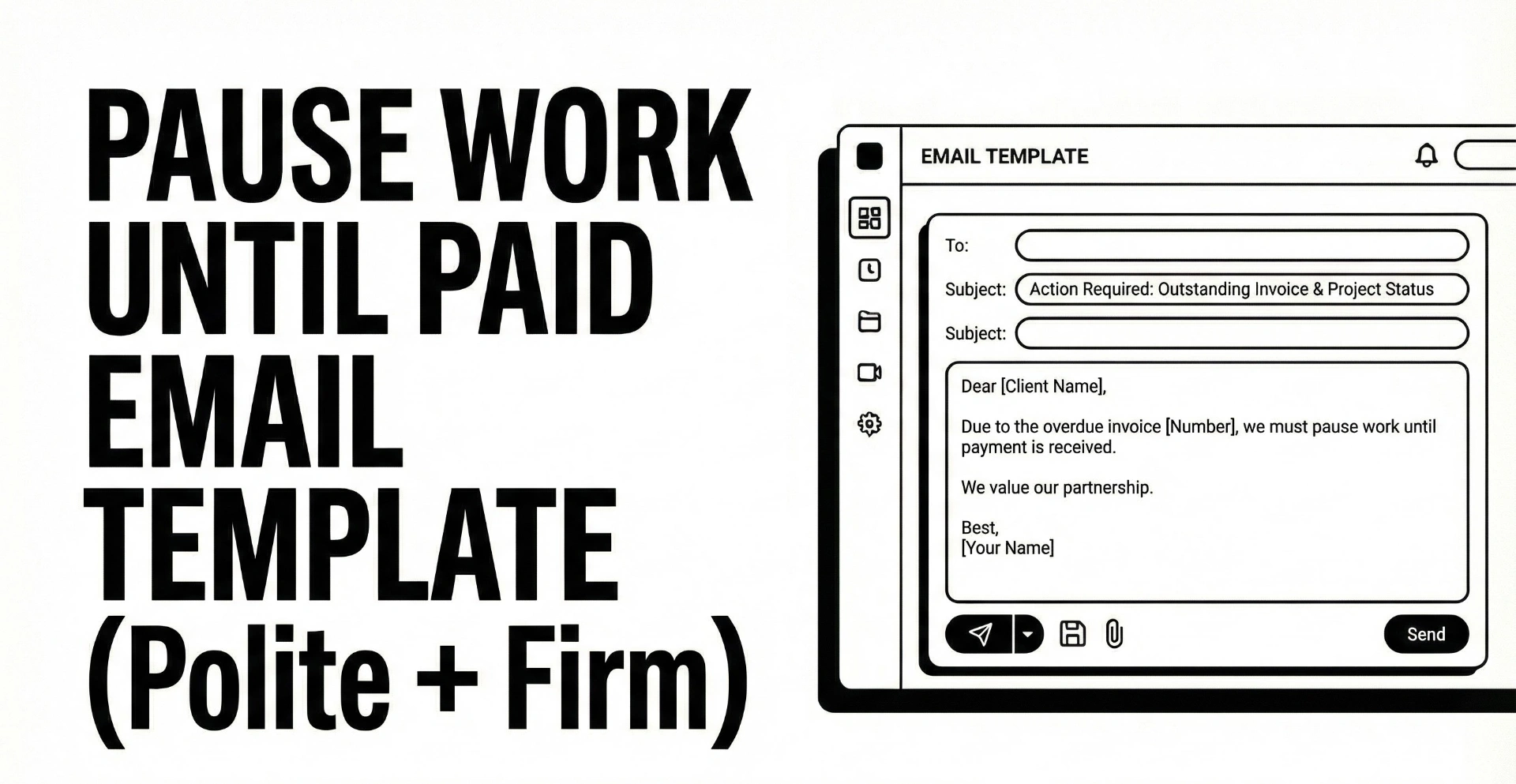
Pause Work Until Paid Email Template (Polite + Firm)
Late invoices are awkward. Not because you do not know what to say, but because you are trying to do two things at once:
- get paid, and
- keep the relationship intact.
A “pause work until paid” email is the moment you stop hinting and start setting a boundary. Done well, it is not aggressive. It is calm, specific, and operational.
This guide gives you copy-paste templates (polite and firm), subject lines, scenario versions for freelancers and agencies, and a simple escalation ladder you can reuse forever.
Key takeaways (read this first)
- Pause work is a boundary, not a threat. Keep it factual, brief, and easy to resolve.
- Do not pause vaguely. Define exactly what pauses (meetings, new deliverables, access, revisions).
- Assume friction before bad faith. Many late payments are admin problems: wrong contact, PO requirement, vendor setup, missing attachment.
- Use a ladder. Friendly reminder → second notice with a payment date → pause work → restart plan.
- Make paying easy in every email. Invoice link, payment link, attachment, and a one-line “reply with what AP needs” option.
- Automate the early steps so you only “go firm” when it truly matters.
When should you pause work for nonpayment?
Pausing work makes sense when continuing would create one of these risks:
- You are funding the project out of pocket (time, subcontractors, ad spend, tools).
- Scope is expanding while the previous milestone remains unpaid.
- The client has missed a promised payment date.
- The invoice is overdue enough that “oops” is no longer the likely explanation.
- Your team is blocked anyway (no approvals), and continuing would just pile up rework.
Many “how to chase invoices” guides recommend escalating from reminders to a work pause when payment still does not arrive.
A practical “pause” threshold (use this as a default)
Use this as a starting point, then adjust for your business:
- Great client, rare delay: pause after 14+ days overdue (or after a missed promised date).
- New client or pattern of delays: pause after 7–10 days overdue.
- Large invoice or milestone payment: pause after 3–7 days overdue, because risk accumulates fast.
- Retainers: pause when the retainer invoice is overdue and the next cycle is about to start.
When not to pause (yet)
Do not jump to a pause-work email if the real issue is likely an admin blocker:
- “We need a PO number.”
- “You are not set up as a vendor.”
- “AP needs your bank details, W-9, VAT, or a vendor form.”
- “The invoice was sent to the wrong person.”
- “We need the invoice as a PDF.”
If you suspect this, solve the blocker first, then choose the right level of follow-up.
If you sell to bigger companies, vendor onboarding is a common hidden reason you are paid late. Use a vendor packet approach instead of sending five separate emails. The checklist in this vendor onboarding checklist makes that fast.
Before you send a pause-work email, run this 2-minute checklist
This checklist prevents the two most common mistakes: pausing too vaguely, and pausing while the client genuinely cannot pay yet due to missing information.
1) Confirm the facts (do not guess)
Include these in the email:
- Invoice number
- Amount
- Due date
- How many days overdue (optional, but helpful when it’s beyond 7 days)
- Payment link or bank details
- Invoice link and/or PDF attachment
Most template guides emphasize the same essentials because they remove confusion and reduce back-and-forth.
2) Make paying easy (reduce friction)
Ask yourself: can the client pay in under 60 seconds from your email?
- If yes, great.
- If no, add what is missing: a link, a PDF, the right contact, the right payment method.
3) Decide what exactly will pause
Pick one of these clear boundaries:
- “We will pause new deliverables and revisions.”
- “We will pause meetings and work in progress.”
- “We will pause launch/handoff until payment is received.”
Avoid vague language like “we’ll have to see,” or “we may need to reconsider.”
4) Choose your tone based on the relationship
If you already have a good relationship, start with the polite pause version. If the client has broken promises or the invoice is materially overdue, use the firm version.
The Calm Escalation Ladder (so you stop improvising)
Most people do not need better “words.” They need a repeatable sequence that escalates calmly.
Here is the ladder:
Stage 1: Friendly reminder (assume oversight)
If you need a starting point, use this polite invoice reminder email template and keep it short.
Stage 2: Second notice (ask for a payment date)
This is the awkward middle zone. You are still professional, but you ask for one concrete outcome: pay now, or confirm the payment date.
Use this second notice overdue invoice email template when you are ready to stop hearing “soon.”
Stage 3: Pause work until paid (this guide)
This is the boundary. You are not debating. You are stating how work will proceed.
Stage 4: Restart cleanly (avoid messy re-entry)
When payment arrives, confirm:
- what you are resuming,
- what the next milestone is,
- how you will avoid the same situation (retainer upfront, milestone rule, automatic reminders).
Timing: stop guessing, use dates
If you want an exact cadence with dates (based on invoice date, due date, and your terms), use an invoice reminder schedule builder instead of “vibes.”
And if you want a full library of pre-due, due-date, overdue, and final templates to support the whole ladder, use these invoice reminder email templates for every stage.
Subject lines that work (polite + firm)
Subject lines should be boring on purpose. Clarity beats clever.
Polite subject lines
- Quick check-in: Invoice [#]
- Follow-up on Invoice [#] (due [Date])
- Invoice [#] payment status
- Can you confirm payment timing for Invoice [#]?
Firm subject lines
- Action required: Invoice [#] overdue
- Payment needed to continue work: Invoice [#]
- Project on hold pending payment (Invoice [#])
- Please confirm payment date for Invoice [#] today
Tip: avoid “FINAL NOTICE” unless you truly mean it and you have a next step ready.
Pause work until paid email template (polite version)
Use this when you believe the client intends to pay, but time is slipping, or you need to protect your schedule.
Best for
- Good clients who are busy
- Accounts Payable delays
- First time you are drawing a boundary
- Relationships you want to preserve
Polite pause-work email (short, copy/paste)
Subject: Project update: invoice [Invoice #] overdue
Hi [Client Name],
Quick follow-up on Invoice [Invoice #] for [Amount], which was due [Due Date].
To keep things tidy on our side, we will pause new work and revisions until the invoice is paid (or until you confirm a payment date from Accounts Payable).
You can pay here: [Payment Link]
Invoice copy: [Invoice Link] (PDF attached if helpful)
If anything is blocking payment (PO, vendor setup, updated details), reply with what you need and I’ll send it today.
Thanks,
[Your Name]
[Company]
[Optional phone]
Polite pause-work email (slightly longer, with options)
Subject: Next steps for Invoice [Invoice #]
Hi [Client Name],
Hope you’re doing well. I’m following up on Invoice [Invoice #] for [Amount] (due [Due Date]).
To avoid work getting ahead of billing, we will pause new deliverables until one of the following happens:
- the invoice is paid, or
- you confirm the payment date you have scheduled.
Pay link: [Payment Link]
Invoice link: [Invoice Link]
If this is in AP right now, a quick reply with the scheduled payment date is perfect. If AP needs anything (PO, vendor form, W-9/VAT, bank details), tell me what and I’ll send it immediately.
Thank you,
[Your Name]
Pause work until paid email template (firm version)
Use this when the invoice is materially overdue, when the client has missed a promised date, or when continuing work creates real business risk.
Best for
- Repeated delays
- Broken payment promises
- High-risk milestones (launch, handoff, production)
- Clients who “go quiet”
Firm pause-work email (copy/paste)
Subject: Work paused pending payment, Invoice [Invoice #]
Hi [Client Name],
Invoice [Invoice #] for [Amount] is now overdue (due [Due Date]).
As per our payment terms, we are placing the project on hold effective today. We will resume work as soon as payment is received (or once you confirm a specific payment date).
Pay here: [Payment Link]
Invoice copy: [Invoice Link]
Please reply today with either:
- confirmation that payment has been initiated, or
- the scheduled payment date.
Thanks,
[Your Name]
[Company]
Firm pause-work email with a deadline and restart plan
Subject: Action required to resume work, Invoice [Invoice #]
Hi [Client Name],
Following up on Invoice [Invoice #] for [Amount] (due [Due Date], now overdue).
We have paused work to prevent further scope and schedule risk. To restart, please do one of the following by [Day, Date, Time zone]:
- pay the invoice via [Payment Link], or
- confirm the payment date and responsible contact in Accounts Payable.
Once confirmed, we will schedule the next work block and share an updated delivery timeline.
Invoice: [Invoice Link]
Regards,
[Your Name]
Scenario templates (freelancers + agencies)
The best pause-work email depends on what you sell. Use the template that matches the “lever” your client cares about.
1) Retainer paused (monthly services)
Subject: Retainer work paused until invoice is settled
Hi [Client Name],
Quick note that the [Month] retainer invoice [Invoice #] for [Amount] is overdue (due [Due Date]).
We have paused retainer work (new requests and non-urgent support) until payment is received. As soon as it is settled, we’ll resume and prioritize any queued items.
Pay link: [Payment Link]
Invoice: [Invoice Link]
If AP needs vendor info, reply with the requirements and we’ll send them today.
Thanks,
[Your Name]
2) Milestone-based project paused
Subject: Milestone work paused pending payment, Invoice [Invoice #]
Hi [Client Name],
The milestone invoice [Invoice #] for [Amount] (due [Due Date]) remains unpaid.
We will pause the next milestone work until the invoice is paid or a payment date is confirmed. This keeps the project aligned with the agreed billing schedule.
Pay: [Payment Link]
Invoice: [Invoice Link]
If there’s a blocker, reply with the exact requirement (PO, vendor form, approval contact) and we’ll resolve it immediately.
Regards,
[Your Name]
3) Handoff/access paused (files, launch, credentials)
Use this carefully. You do not want to sound punitive. You want to be operational.
Subject: Handoff scheduled after payment confirmation
Hi [Client Name],
Following up on Invoice [Invoice #] for [Amount], due [Due Date].
We are ready to complete the next step (handoff / launch / credentials). To keep everything aligned with our payment terms, we’ll schedule the handoff immediately after we receive payment confirmation.
Pay link: [Payment Link]
Invoice: [Invoice Link]
If payment is already in progress, reply with confirmation and we’ll book the handoff slot.
Thanks,
[Your Name]
4) If there’s a dispute (pause while clarifying)
If the client is unhappy, do not mix “collections” with “argument.” Separate them cleanly.
Subject: Pausing work while we resolve Invoice [Invoice #]
Hi [Client Name],
Thanks for your note. I want to resolve this properly.
For now, we are pausing new work while we align on the outstanding items tied to Invoice [Invoice #] for [Amount] (due [Due Date]).
To move quickly, can you reply with:
- the specific line item(s) you are disputing, and
- what would make this invoice approved (example: one revision, a meeting, a corrected PO).
Once confirmed, we can either (a) proceed with a small fix and reissue, or (b) close this invoice and move forward.
Invoice: [Invoice Link]
Regards,
[Your Name]
What to do when they reply (scripts that keep it moving)
If they say: “Payment is in progress”
Reply with a simple confirmation ask:
Thanks, appreciated.
Can you confirm the payment date and the last 4 digits / reference (if available)? Once confirmed, we’ll schedule the next work block.
If they say: “We need a PO / vendor form / W-9 / VAT / bank details”
This is common in B2B. Treat it like a checklist, not a conversation.
Absolutely, happy to help.
Please confirm which of the following AP needs: PO number, vendor form, W-9 (US), VAT ID (EU/UK), bank details, registered address, or invoice format requirements. I can send a complete vendor packet today.
If you want the full list, use this vendor packet for Accounts Payable checklist so you stop losing days to “one more thing.”
If they say: “We pay on net 60”
Two choices: accept it, or renegotiate the terms for the next cycle.
Option A (accept, but set clarity):
Understood. Can you confirm the scheduled pay run date for Invoice [#]? We’ll align our reminders to that date.
Option B (renegotiate for next time):
Thanks, that helps. For future work, we’ll need to align terms to [Net 14/Net 30] or move to milestone billing so we can keep delivery moving without long financing gaps.
If they say: “Cash flow is tight, can we do a plan?”
Offer structure, not sympathy-only.
Thanks for letting me know. We can do a short payment plan so this stays on track.
Would one of these work?
- 50% today, 50% on [Date]
- [Amount] per week for [X] weeks, starting [Date]
Once we agree, we’ll resume work based on the plan.
If they do not reply
Do not send five “just following up” messages. Send one clean escalation:
- Restate the facts
- Restate the boundary
- Give one clear action (pay or confirm date)
- Give a deadline
- Mention the next step (example: “we will keep the project on hold”)
If you need a standardized cadence, generate one with this reminder schedule with exact dates and stick to it.
Put it in your process (so this becomes rare)
A pause-work email is much easier to send when it is not emotional, because it is policy.
Add a “pause policy” to onboarding
In your kickoff email or onboarding doc, add a simple line:
“Work is scheduled based on invoices being current. If an invoice becomes overdue, we may pause work until payment is received or a payment date is confirmed.”
This makes the pause email feel like a reminder of the process, not a personal confrontation.
If you want a broader system view (onboarding, reminders, escalation), use this practical system to reduce late payments and adapt it to your reality.
Contract clause example (discussion starter, not legal advice)
Many standard service agreements include the concept of suspending work for nonpayment with notice. For example, the AIGA standard agreement includes a “work stoppage” option in its template.
Here is plain-language example wording to discuss with your lawyer:
If invoices are not paid within [X] days of the due date, Provider may suspend services until all past-due amounts are paid. Any project timelines may shift accordingly.
Also consider specifying:
- late fees (if applicable and legal in your jurisdiction),
- what happens to deadlines during a pause,
- what “resume” means (next available slot vs immediate).
If you want a ready-made contract structure and optional clauses (late fees, milestones), Freelancers Union’s contract tools can be a helpful reference point.
Templates are good, automation is better (for the early steps)
You should not be writing custom emails every time an invoice is a few days late. Automate the boring steps so your “firm” messages are rare.
- Many invoicing systems can send reminders. For example, QuickBooks documents how to schedule automatic invoice reminders and notes you can schedule them up to 90 days before or after the due date.
- The key is consistency: the client learns that invoices are followed up the same way, every time.
If you want the concept and the workflow, start here: automatic invoice reminders.
And if you want quick tone variants to adapt to your situation (friendly → neutral → firm), use the invoice reminder email generator to produce a version you can send in 30 seconds.
Conclusion
A “pause work until paid” email is not about being harsh. It is about being clear.
When you:
- send reminders on a predictable schedule,
- remove payment friction,
- ask for a real payment date,
- and pause work with a calm boundary,
you stop chasing, and you start running a process.
If you want a reminder layer built specifically for this, check out Can You Pay That, automatic invoice reminders for agencies and freelancers.
FAQ
What does “pause work until paid” mean?
It means you temporarily stop providing new work (deliverables, revisions, meetings, or handoffs) until an overdue invoice is paid or a payment date is confirmed.
How do you say it politely?
State the facts (invoice number, amount, due date), state the boundary (we will pause new work), and offer a fast resolution path (pay link or confirm AP payment date).
When should I send a pause-work email?
Commonly after a second notice, or when the invoice is materially overdue and continuing work increases your risk. A structured escalation approach is widely recommended.
Should I call before sending it?
If it’s a high-value client or a large invoice, a short call can resolve admin blockers quickly. Otherwise, email first, then call if there’s no response.
Can I charge late fees?
Sometimes, but it depends on your contract and local laws. If you use late fees, make sure they’re documented upfront in writing.
What if the client needs vendor onboarding?
Send a complete vendor packet (tax form, bank details, legal name, address, VAT/W-9, primary AP contact) and ask for the pay-run date.
How do I restart work after payment?
Confirm payment received, confirm what you are resuming, and set the next milestone and billing point so you do not repeat the same problem.