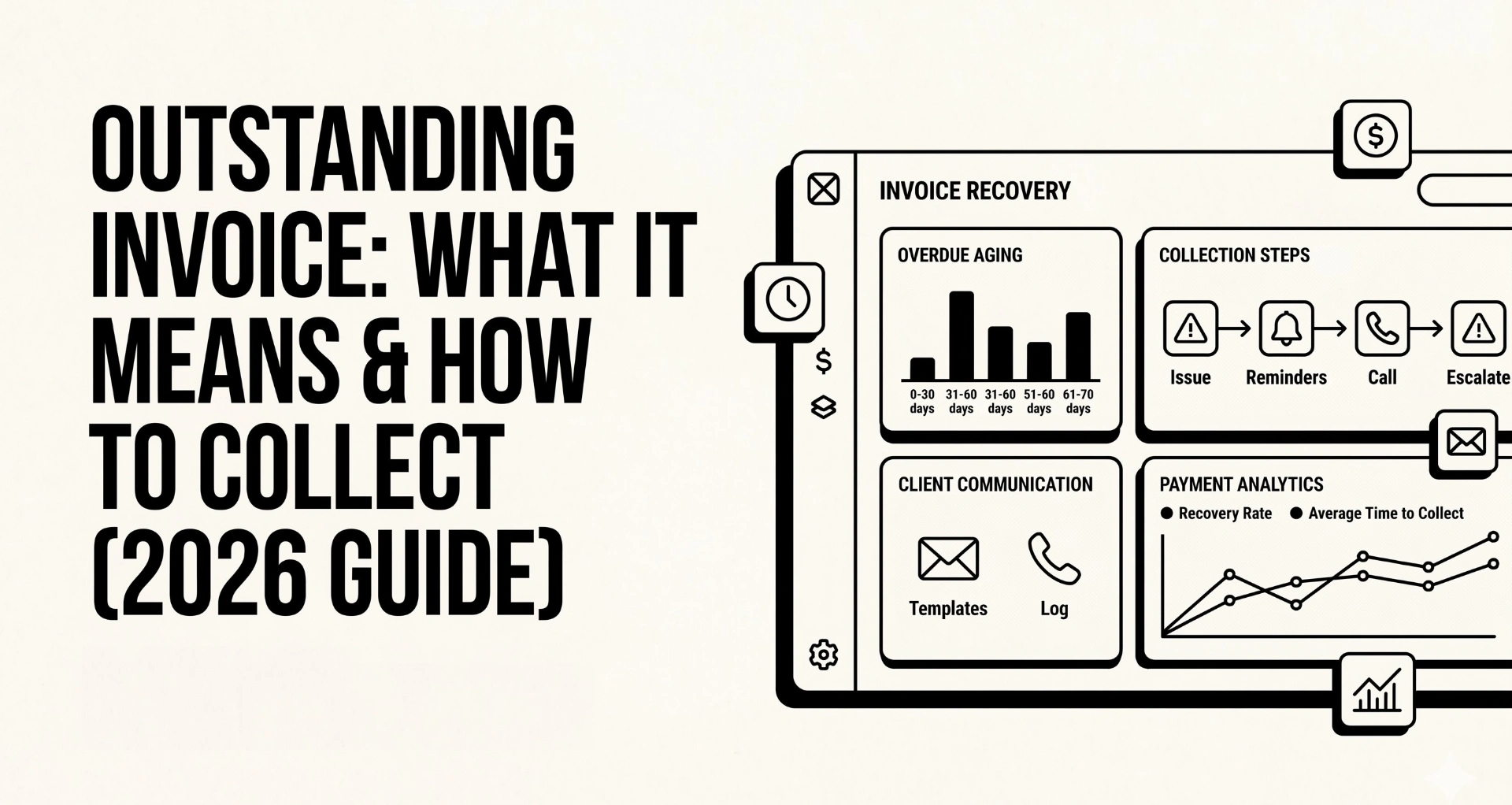
Outstanding Invoice: What It Means & How to Collect (2026 Guide)
An outstanding invoice is any invoice you've sent that hasn't been paid yet — whether it's due next week or 90 days late. Left unmanaged, outstanding invoices quietly drain your cash flow, your time, and your sanity. The good news: you can shrink your outstanding balance with a simple, repeatable system. This guide walks you through what "outstanding" really means, how it differs from "overdue," and the exact steps to collect what you're owed without burning client relationships.
What Is an Outstanding Invoice? (Definition)
An outstanding invoice is an invoice that has been issued and sent to a customer but has not yet been paid in full. It remains on your books as a receivable — money owed to you — until the customer pays it or you write it off.
The word "outstanding" is purely a status label. It tells you nothing about whether the invoice is late, just that the cash hasn't landed in your account yet. An invoice you sent this morning with Net 30 payment terms is outstanding. An invoice from 2022 that no one ever paid is also outstanding (although by that point, you'd more accurately call it a bad debt).
Outstanding invoice meaning, in plain English: "We've billed for this work. The customer hasn't paid yet. We're still expecting the money."
Where outstanding invoices show up in your accounting
In double-entry bookkeeping, every outstanding invoice is recorded as accounts receivable (A/R) — an asset on your balance sheet. When the customer pays, the amount moves from accounts receivable to cash. The total of all your outstanding invoices at any given moment is your A/R balance, and it's one of the most important numbers in your business.
Outstanding vs. Overdue Invoices: What's the Difference?
This is where most people get tripped up. "Outstanding" and "overdue" are not synonyms, and confusing them leads to awkward conversations with clients ("Wait, you're calling me to chase a payment that isn't even due yet?").
So every overdue invoice is outstanding, but not every outstanding invoice is overdue. A healthy business will always have some outstanding invoices on the books — that's just normal Net 15 / Net 30 terms doing their thing. The number you actually want to monitor is the aging of those outstanding invoices.
For a deeper dive on payment terminology, see our guide on Net 30 payment terms.
Why Outstanding Invoices Quietly Kill Small Businesses
Most small businesses don't fail from a lack of revenue. They fail from a lack of cash. And outstanding invoices are the gap between the two.
Consider a freelancer who books $15,000 of work in a month. On paper, that's a great month. But if $12,000 of those invoices are still outstanding 45 days later, that freelancer can't pay rent, can't pay subcontractors, and can't take on new work because they're spending their days chasing payments instead of doing the work.
The real cost of outstanding invoices
If you've felt any of this lately, the system in our guide on how to reduce late payments from clients is a great place to start.
Why Invoices Go Unpaid (It's Usually Not Malice)
Before you assume the worst about a non-paying client, it helps to understand the most common — and often boring — reasons invoices stay outstanding:
- The invoice never arrived. It went to spam, it was sent to the wrong person, or the AP contact left the company.
- It's stuck in approval. Larger companies route invoices through procurement, project managers, and finance. A single missing PO number can stall an invoice for weeks.
- The client forgot. Genuinely. Especially small business owners juggling 50 things at once.
- There's a dispute. The client thinks something is wrong with the invoice, the work, or the amount — but hasn't told you.
- Payment friction. The client wants to pay but can't easily because there's no payment link, only a bank wire requested, or a portal login they've forgotten.
- Cash flow on their end. The client is short on cash and is silently delaying payment.
- Bad faith. Rare, but real. Some clients deliberately stall.
The takeaway: most outstanding invoices are not personal. They're operational. That means most of them can be solved with a clear, polite, well-timed nudge.
How to Collect an Outstanding Invoice: A 7-Step System
Here's a sequence that works for solo freelancers and small agencies. The goal is to be persistent without being annoying, and firm without being aggressive.
Step 1: Confirm the invoice was actually received
Before you assume the client is ignoring you, verify the basics:
A quick "Just confirming you received this — let me know if anything is missing" is often enough to surface a delivery problem on day 1.
Step 2: Send a friendly pre-due reminder
Don't wait until the due date passes. A short, low-pressure reminder 3–7 days before the due date is one of the highest-ROI emails you can send. It signals professionalism, gets your invoice in front of the client at the right time, and preempts the "Oh, sorry, I forgot" excuse.
Use the free Invoice Reminder Schedule Builder to map out the exact dates, or grab ready-to-send copy from our invoice reminder email templates.
Step 3: First overdue nudge (1–3 days late)
Keep it light. Assume good faith. Reference the invoice number, the amount, and the original due date. Make it easy to pay — include the payment link directly in the email.
If you need help with tone and wording, our guide on how to ask for invoice payment politely has 12 templates you can copy and adapt.
Step 4: Second reminder (7–10 days late)
Slightly firmer. State the amount, the due date that has now passed, and a specific question: "Can you confirm when this will be paid?" Asking a direct question prompts a direct response — vague messages get vague replies.
Our second notice overdue invoice template walks through the exact wording.
Step 5: Phone call (14+ days late)
This is the step most freelancers skip — and it's the one that works. After two emails go unanswered, pick up the phone. Calls are harder to ignore than emails, and they often surface the real reason behind the delay (dispute, cash flow, lost paperwork) in 90 seconds.
Keep the call short, polite, and solution-oriented: "Hi, I'm following up on invoice #1042 from [date]. Just wanted to make sure it's in your system and check when I can expect payment."
Step 6: Final notice + late fees (30+ days late)
At 30 days past due, the conversation changes. Send a written final notice that:
If late fees are part of your terms, calculate them precisely with our free Late Payment Fee Calculator. Charging fees isn't about punishing the client — it's about pricing in the cost of capital you're effectively lending them.
Step 7: Escalate (60+ days late)
If you're still not paid after 60 days, your options narrow to:
Whatever you do, don't keep doing more work for a client who hasn't paid for the previous batch. Pause new work the moment an invoice goes 30+ days past due.
How to Read an A/R Aging Report
An accounts receivable aging report is the most useful single document for managing outstanding invoices. It groups your unpaid invoices into time buckets so you can see what's healthy, what's at risk, and what's nearly lost.
If more than ~20% of your A/R sits in the 30+ days bucket on a regular basis, you have a collection process problem — not just a bad-client problem.
Days Sales Outstanding (DSO): The One Number to Watch
Days Sales Outstanding (DSO) tells you the average number of days it takes to get paid after invoicing. It's the single best metric for diagnosing whether your outstanding invoice problem is getting better or worse.
The formula:
DSO = (Accounts Receivable ÷ Total Credit Sales) × Number of Days
Example. You ended the quarter with $30,000 in outstanding invoices on $90,000 of credit sales over 90 days:
DSO = ($30,000 ÷ $90,000) × 90 = 30 days
If your standard terms are Net 30, a DSO of 30 is right on target. A DSO of 50 means clients are dragging payments by 20 extra days on average — and that 20 days is your money sitting in their bank account.
What's a "good" DSO?
How to Prevent Outstanding Invoices in the First Place
The best collection strategy is the one you don't have to use. These habits dramatically reduce the number of invoices that ever go past due:
1. Invoice immediately after delivery
The "fresh memory" effect is real. Clients pay invoices faster when the work is still on their mind. Don't batch invoices monthly if you can help it — invoice the day the milestone is delivered.
2. Use shorter payment terms
Net 30 is a tradition, not a law. Many freelancers safely use Net 14 or even Due on Receipt. We compare every option in our Net 30 payment terms guide.
3. Make it absurdly easy to pay
Every payment method you don't accept is a delay you've built into the process. Add a payment link directly to your invoice — credit card, ACH, or both. We cover the full setup in our guide on how to accept credit card payments on invoices.
4. Send reminders automatically
Manual reminders fall through the cracks the moment you get busy. Set up an automated cadence — pre-due, due date, +3 days, +7 days, +14 days — and let the system do the chasing. Use the Invoice Reminder Schedule Builder to design yours.
5. Get a written agreement before starting work
A simple contract that spells out scope, deliverables, payment terms, and late fees prevents 90% of payment disputes. Our freelance contract guide has a template you can use today.
6. Require a deposit on larger projects
For any project over a certain threshold (e.g., $1,500+), ask for 30–50% upfront. Clients who balk at deposits often turn out to be the same ones who balk at paying invoices.
7. Charge late fees — and mean it
Late fees aren't about money. They're about signal. They tell clients you treat your business like a business. Even a 1.5% monthly fee changes behavior over time.
When to Escalate vs. When to Walk Away
Not every outstanding invoice is worth chasing to the end. Use this rough decision framework:
Outstanding Invoice Best Practices Checklist
Frequently Asked Questions
What does "outstanding invoice" mean exactly?
An outstanding invoice is any invoice that has been sent to a customer but not yet paid in full. It can be either current (not yet past its due date) or overdue (past the due date). Until the customer pays, the amount sits in your accounts receivable as money owed to you.
Is an outstanding invoice the same as an overdue invoice?
No. All overdue invoices are outstanding, but not all outstanding invoices are overdue. An invoice you sent yesterday with Net 30 terms is outstanding for the next 30 days, but it isn't overdue until the due date passes.
How long can a customer keep an invoice outstanding?
Legally, most jurisdictions allow you to pursue an unpaid invoice for several years (often 4–6 years, depending on local statutes of limitation). Practically, the longer an invoice stays outstanding, the harder it gets to collect — collection probability drops sharply after 90 days.
What's the first thing I should do when an invoice goes unpaid?
Confirm the invoice was actually received and went to the right billing contact. A surprising number of "ignored" invoices were never seen. A short "just confirming you got this" email solves the problem in many cases.
Can I charge interest on outstanding invoices?
Yes — as long as the late fee or interest rate is disclosed in your contract or on the invoice itself. Common rates are 1–2% per month. Use our Late Payment Fee Calculator to compute the exact amount.
How do I write off an outstanding invoice as bad debt?
If you've genuinely exhausted collection options, you can write the invoice off your books and (in most jurisdictions) claim it as a tax deduction. Talk to your accountant about the specifics — the rules differ for cash-basis vs. accrual-basis businesses.
Should I keep working with a client who has outstanding invoices?
Stop new work the moment an invoice goes 30+ days past due. Continuing to deliver value to a non-paying client trains them to keep not paying — and increases the size of your eventual write-off if they never come back.
What's a healthy ratio of outstanding invoices to revenue?
It depends on your payment terms, but a useful rule of thumb: your A/R balance should roughly equal your average monthly revenue if you're on Net 30 terms. Anything significantly higher signals a collections problem.
How can I reduce the number of outstanding invoices?
The biggest levers are: invoice immediately after delivery, shorten payment terms where possible, accept credit card and ACH payments, automate reminders, and require deposits on larger projects. Our practical system for reducing late payments walks through each one.
What's the difference between an outstanding invoice and accounts receivable?
An outstanding invoice is a single unpaid invoice. Accounts receivable (A/R) is the total of all your outstanding invoices added together. A/R is the line on your balance sheet; outstanding invoices are the individual transactions that make it up.
The Bottom Line
Outstanding invoices are a normal part of doing business — but they shouldn't be a permanent one. The freelancers and small businesses that thrive aren't the ones who never have outstanding invoices. They're the ones who have a boring, repeatable system for turning outstanding into paid as quickly as possible.
Pick three habits from this guide and start this week: send a pre-due reminder on every invoice, accept credit card payments, and run an aging report every Monday morning. That alone will move the needle within 30 days.
And if you'd like all of this on autopilot — invoices, reminders, payment links, aging reports — that's literally what we built Can You Pay That to do.